



135 $
We currently only accept Crypto payments on the website. If you’d like to pay via PayPal or Credit Card, please contact us via email shoppycourses@gmail.com and we will provide you with a secure payment link

 GET EXTRA DISCOUNTS
 CHECK ALL OUR EXCLUSIVE COURSES HERE
 Sale Page: https://exponential.su.org/details-v4-futureproof
👉 Check All Exclusive Courses HERE 👈
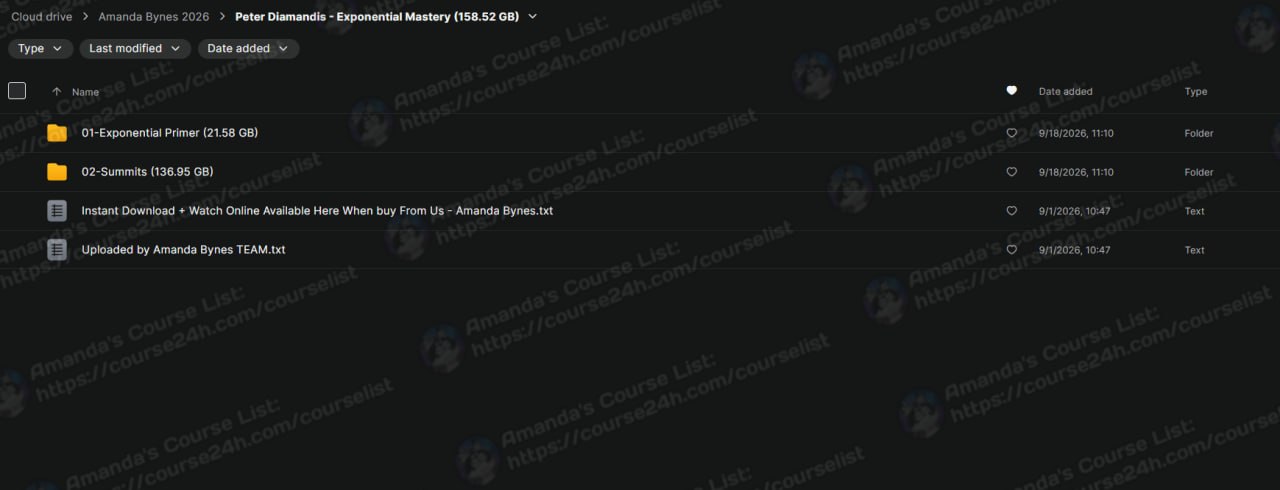
Proof Download
Peter Diamandis – Exponential Mastery
Learning To Think Ahead In An Exponential World
Technology is changing faster than many traditional business models can comfortably absorb.
Artificial intelligence, robotics, biotechnology, quantum computing, digital manufacturing, blockchain, autonomous transportation,
and other emerging technologies are developing simultaneously, creating new opportunities while challenging established assumptions.
Exponential Mastery is designed around the idea that understanding technological acceleration requires more than simply following technology news.
The program provides a structured framework for examining exponential change, recognizing emerging patterns,
and thinking about how those developments could affect entrepreneurship, investment, leadership, and long-term career strategy.
The program is curated around the work and frameworks of Peter H. Diamandis and combines foundational training with access to
broader content surrounding exponential technologies, entrepreneurial mindsets, moonshot thinking,
and future-focused business strategy.

Six Mindsets For Exponential Entrepreneurs
Another important component of Peter Diamandis – Exponential Mastery is its focus on entrepreneurial mindset.
The Exponential Primer introduces six mindsets associated with exponential entrepreneurship:
Purpose-driven thinking
Exponential thinking
Abundance thinking
Curiosity
Moonshot thinking
Longevity thinking
These concepts provide a broader framework for considering how entrepreneurs approach uncertainty, ambitious goals, technological opportunities,
and long-term impact.
Turning Technology Awareness Into Strategic Thinking
A major theme running through Exponential Mastery is the transition from simply knowing about emerging technology to thinking strategically about it.
For entrepreneurs, this can mean asking:
Which technologies could change my industry?
Where could two or more technologies converge?
What assumptions might become obsolete?
Which business models could emerge from new capabilities?
What should the organization begin experimenting with today?
What opportunities could become more obvious several years from now?
For investors, the same framework can encourage deeper questions about technological adoption, market creation, competitive advantages, and emerging sectors.
For business leaders, it can provide a way to think about future-proofing operations and preparing teams for technological transitions.
Be the first to review “Peter Diamandis – Exponential Mastery”
Related products





Business


Business

Reviews
There are no reviews yet.