



25 $
We currently only accept Crypto payments on the website. If you’d like to pay via PayPal or Credit Card, please contact us via email shoppycourses@gmail.com and we will provide you with a secure payment link

 GET EXTRA DISCOUNTS
 CHECK ALL OUR EXCLUSIVE COURSES HERE
 Sale Page: https://www.printfarmacademy.com/
👉 Check All Exclusive Courses HERE 👈
Proof Download
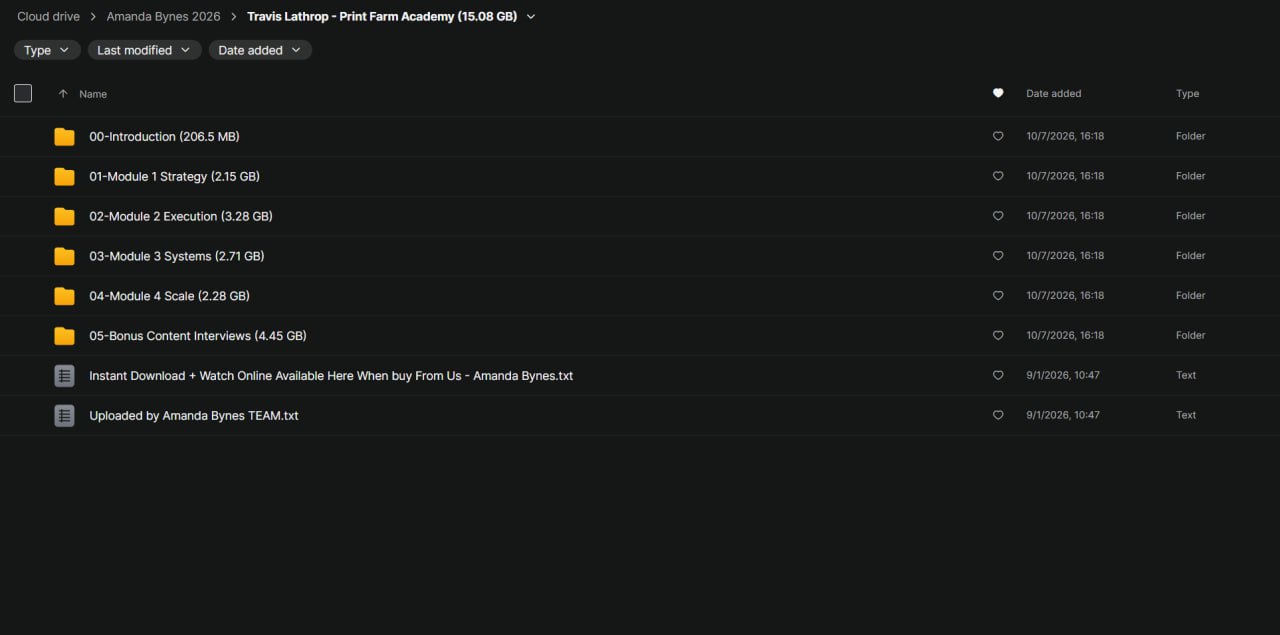
Travis Lathrop – Print Farm Academy
Turning 3D Printing Skills Into a Business With Real Structure
3D printing opens the door to a wide range of commercial possibilities, from customized accessories and practical household products
to specialized components and niche merchandise.
Yet owning a printer and producing attractive objects are only two parts of building a sustainable business.
Entrepreneurs must also identify products people want, understand their target market, calculate costs, develop a recognizable brand,
and create reliable systems for handling orders.
Travis Lathrop – Print Farm Academy approaches 3D printing from this business-building perspective.
Rather than concentrating exclusively on machine operation or technical printing skills,
the program focuses on the commercial decisions involved in turning an interest in additive manufacturing into a structured business.
The central idea is straightforward: a profitable print farm needs more than equipment.
It needs a clear market position, a viable product strategy, disciplined execution, and processes that can support growth
without allowing operational complexity to overwhelm the owner.
For aspiring entrepreneurs, this approach offers a framework for moving beyond occasional sales toward a more deliberate business model.
For people who already sell printed products, it provides a way to examine existing operations and identify opportunities to improve efficiency,
strengthen positioning, and expand into new markets.

Creating a Production Workflow That Can Handle Growth
A home-based print operation may begin with one machine and a small number of orders. As demand increases, the same informal approach can become a bottleneck.
Orders need to be tracked, print jobs scheduled, materials replenished, machines maintained, quality checked, and finished products packaged.
Without clear procedures, the owner can spend more time managing interruptions than improving the business.
The systems module in Print Farm Academy focuses on production efficiency, operational reviews, fulfillment, and identifying constraints that limit performance.
This makes process design a central consideration for anyone who wants to scale beyond occasional production.
A repeatable workflow might include:
Recording incoming orders and required delivery dates.
Grouping compatible print jobs where practical.
Monitoring material availability and machine condition.
Checking completed products against defined quality standards.
Maintaining a clear procedure for failed prints and reprints.
Organizing packaging and shipping supplies.
Reviewing production time and fulfillment costs regularly.
These procedures can help make the business more predictable.
They also provide a baseline for identifying where investment in additional equipment, improved tooling, or automation could have the greatest impact.
Adding printers without improving the workflow may simply multiply existing problems.
A more thoughtful approach is to identify the current bottleneck, test an improvement, and measure whether the change increases useful output or reduces costs.
Knowing When to Invest in More Printers
Before making a significant investment, an entrepreneur should understand whether current demand can justify the additional capacity.
A practical expansion decision begins with reviewing existing operations. Are machines consistently busy producing products that sell?
Are orders being delayed because of insufficient capacity, or are delays caused by finishing, packaging, or marketing?
Is demand stable enough to support higher fixed costs?
These questions help distinguish a genuine capacity constraint from a problem that requires a different solution.
The systems and scale components of Print Farm Academy address sustainable operations, business audits, scaling systems, and expansion into new markets.
This framework encourages owners to treat growth as an operational decision rather than an automatic response to increased sales.
Useful performance measures can include:
Revenue and contribution margin by product.
Average production time per sellable unit.
Machine utilization and downtime.
Failed-print and rework rates.
Order fulfillment time.
Inventory levels and cash tied up in materials.
Customer acquisition costs and repeat-purchase behavior.
No single metric tells the entire story.
However, reviewing these indicators together can help owners make better decisions about which products to prioritize,
where to improve efficiency, and when additional capacity may be justified.
Be the first to review “Travis Lathrop – Print Farm Academy”
Related products

Business

Business


Business

Business


Reviews
There are no reviews yet.