

20 $
We currently only accept Crypto payments on the website. If you’d like to pay via PayPal or Credit Card, please contact us via email shoppycourses@gmail.com and we will provide you with a secure payment link

 GET EXTRA DISCOUNTS
 CHECK ALL OUR EXCLUSIVE COURSES HERE
 Sale Page: https://mariawendt.samcart.com/products/carousels-that-convert
👉 Check All Exclusive Courses HERE 👈
Proof Download
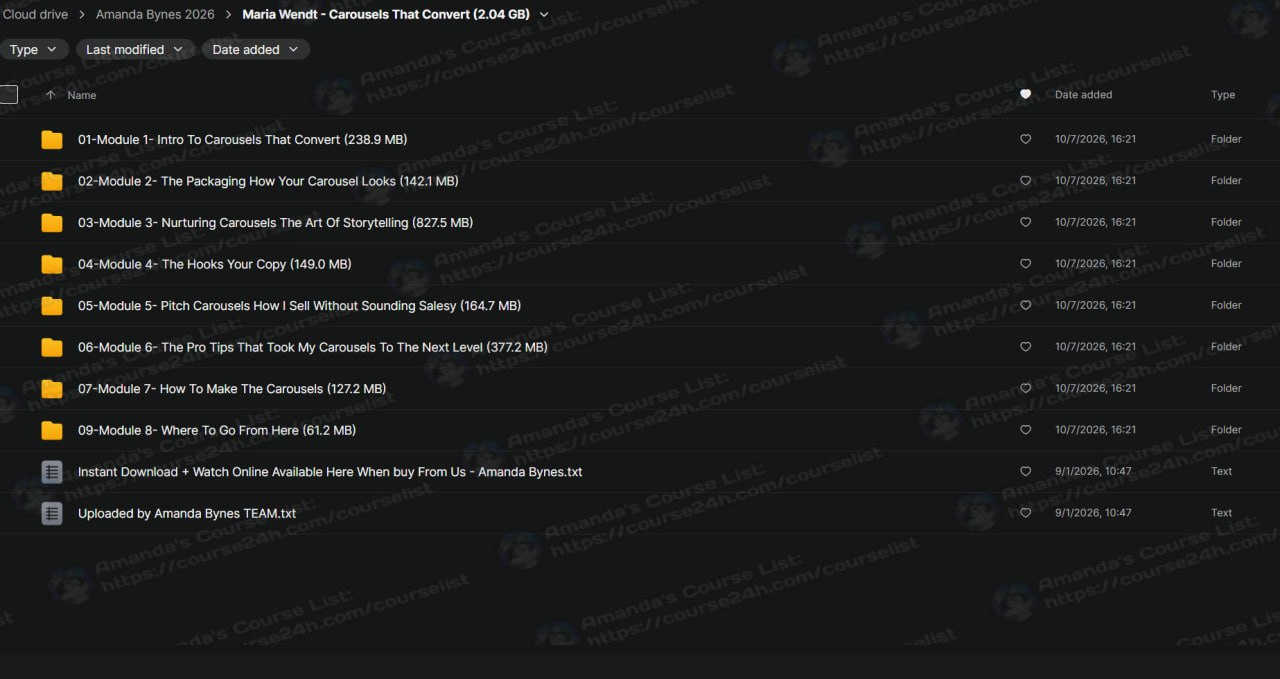
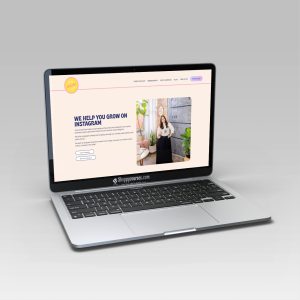
Maria Wendt – Carousels That Convert
Why Some Instagram Carousels Do More Than Capture Attention
Instagram content can attract attention without contributing much to a business.
A post might receive likes, comments, and profile visits while generating few inquiries or sales.
For creators, coaches, service providers, and digital product sellers, the challenge is not simply producing content that people enjoy.
It is creating content that helps the right audience understand a problem, recognize a solution, and take the next step.
Carousels That Convert centers on the commercial potential of Instagram carousel content.
Rather than treating every post as an isolated attempt to gain engagement, the subject encourages a more intentional approach to communicating ideas
across multiple slides and connecting that communication to a business objective.
A carousel offers room to develop an argument, explain a process, challenge an assumption, or demonstrate the value of an offer.
Each slide can move the reader from one idea to the next, making the format particularly useful for educational content, practical advice,
storytelling, and product-related messaging.
The opportunity lies in combining clear writing, thoughtful sequencing, audience understanding, and a relevant call to action.
When these elements work together, a carousel can become more than a visual post.
It can serve as a repeatable component of a broader content marketing strategy.
Creating a Visual Experience That Supports the Message
Effective design starts with readability rather than decoration.
A clear headline, manageable text blocks, sufficient contrast, and consistent spacing help readers identify the main idea quickly.
Repeated visual elements can also make a creator’s content recognizable across multiple posts.
However, visual consistency should not become an excuse for repetitive or monotonous content.
A tutorial may need numbered steps, while a comparison could benefit from two clearly differentiated columns.
A storytelling carousel might use a more varied visual rhythm to support the narrative.
The design should follow the purpose of the message.
Practical considerations include:
Keep text readable on a mobile screen.
Use typography consistently to establish a clear hierarchy.
Avoid placing too many unrelated ideas on one slide.
Use diagrams, examples, or visual comparisons when they clarify the explanation.
Maintain enough visual consistency to support brand recognition.
Check the finished carousel at mobile size before publishing.
Templates can help reduce production time, but they work best as a starting point.
Each post still needs a distinct message, relevant examples, and a layout that supports the content.
Building a Repeatable Content Creation Workflow
Producing individual carousels can be manageable at first.
Maintaining a consistent publishing schedule becomes more difficult when every post requires starting from a blank page.
A repeatable workflow can reduce unnecessary decisions and help creators spend more time improving the quality of their ideas.
The process can begin with audience research. Questions from customers, recurring objections, comments, frequently discussed problems,
and search behavior can all provide potential content topics.
Those topics can then be grouped into broader themes, such as educational guidance, common mistakes, practical demonstrations,
industry misconceptions, and offer-related questions.
From there, the creator can move through a consistent production sequence:
Select one audience problem or question.
Define the purpose of the carousel.
Write the central takeaway in one sentence.
Choose a suitable structure for the information.
Draft the opening and slide-by-slide copy.
Edit for clarity, relevance, and unnecessary repetition.
Design the slides using a readable visual system.
Review the call to action and publish.
Record performance and note potential improvements.
Batching similar tasks can make the workflow more efficient.
For example, researching several topics in one session and writing multiple drafts in another may reduce the effort involved in repeatedly
switching between creative activities.
The workflow should remain flexible enough to accommodate timely topics, customer feedback, and new business priorities. Efficiency matters, but publishing m
Be the first to review “Maria Wendt – Carousels That Convert”
Related products

Facebook Ads




Reviews
There are no reviews yet.