


20 $
We currently only accept Crypto payments on the website. If you’d like to pay via PayPal or Credit Card, please contact us via email shoppycourses@gmail.com and we will provide you with a secure payment link

 GET EXTRA DISCOUNTS
 CHECK ALL OUR EXCLUSIVE COURSES HERE
 Sale Page: https://aicontentengine.co/ai-videos-1#section-RhBiUHaxgb
👉 Check All Exclusive Courses HERE 👈
Proof Download
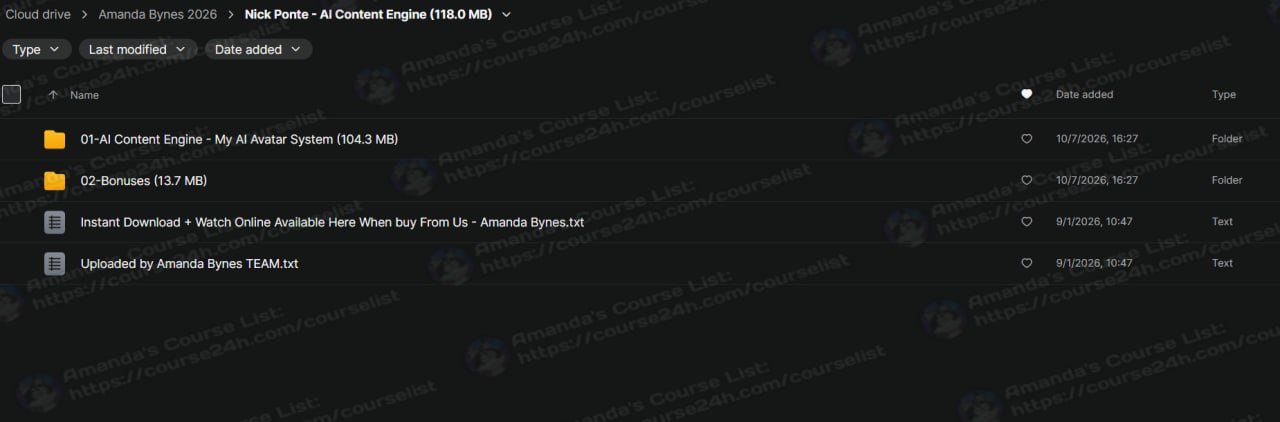
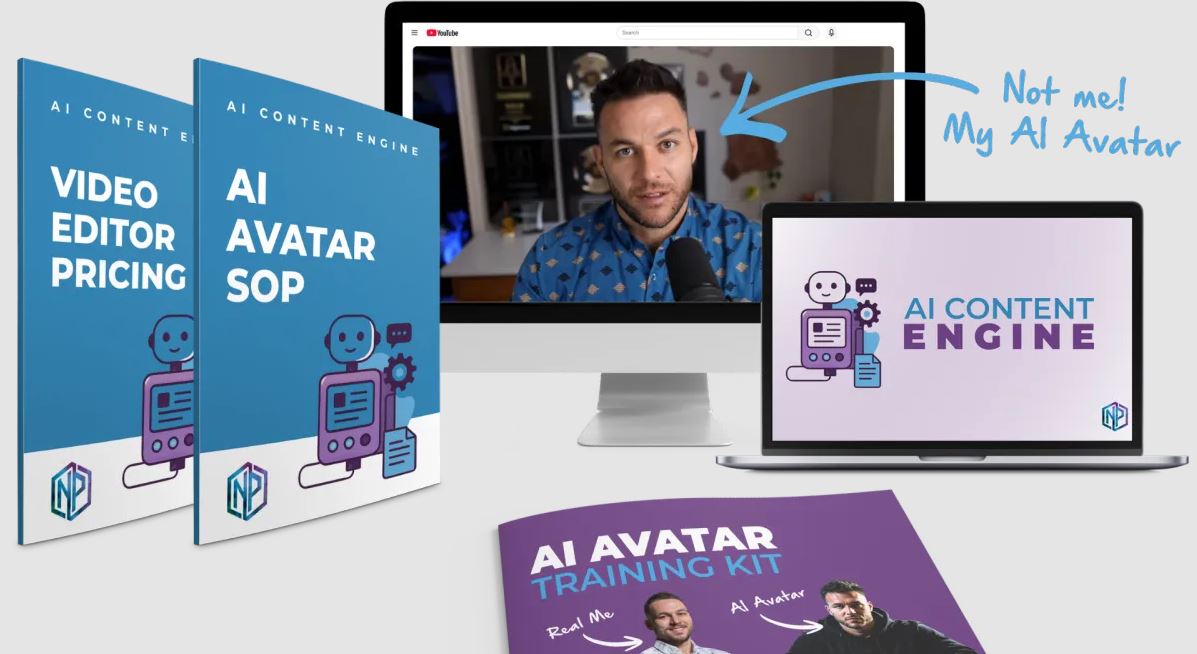
Nick Ponte – AI Content Engine
From Manual Video Production to a Repeatable Content Machine
Consistent video publishing can be difficult for entrepreneurs who must balance marketing with sales, client delivery, and daily business operations.
Researching topics, writing scripts, recording footage, editing videos, designing thumbnails, and managing distribution can turn content creation into
a time-consuming process.
For business owners who want to build an audience without appearing on camera for every video, AI-powered production offers another approach.
Digital avatars, AI-assisted scripting, and structured editing workflows can help reduce the manual effort involved in creating educational
and promotional content.
AI Content Engine focuses on turning these individual tasks into a coordinated video production system.
Rather than treating AI as a shortcut for generating generic videos,
the program emphasizes the relationship between topic selection, scripting, avatar creation, editing, packaging, publishing, and performance analysis.
The underlying principle is that effective automation begins with a well-designed process. AI tools can accelerate production,
but the content still needs a clear purpose, an interesting subject, a compelling narrative, and a reason for viewers to keep watching.
For creators, consultants, agency owners, and entrepreneurs,
this approach provides a framework for building a more consistent video presence without personally managing
every production task from beginning to end.
Writing Video Scripts Designed to Hold Attention
A good script gives a video direction. It establishes what the viewer should learn, how the information will be presented, and why the next section is worth watching.
AI can help with outlining, drafting, rewriting, and generating alternative hooks.
However, unedited AI-generated scripts often contain repetitive explanations, broad claims, and unnecessary introductions that make videos feel generic.
The AI Content Engine advertises a high-retention scripting framework involving hooks, narrative structure, open loops, calls to action,
and Claude-based prompting systems.
These elements can help creators organize videos around a specific viewer experience.
A useful script structure might include:
Opening hook: Introduce the problem, question, or surprising insight.
Context: Explain why the topic matters to the viewer.
Main explanation: Present the central ideas in a logical sequence.
Examples: Demonstrate how the concepts work in practice.
Payoff: Resolve the question or deliver the promised insight.
Call to action: Suggest an appropriate next step.
The sequence should reflect the video’s purpose rather than follow a rigid formula.
For an educational video, the payoff may be a practical method or a clear explanation.
For a product-focused video, it may be a demonstration of how a solution works.
For a business-development video, the next step could be exploring a service or requesting more information.
A strong script also avoids misleading hooks. The opening should create interest without promising information the video never delivers.
Using AI Prompts as a Structured Production Toolkit
Prompting becomes more useful when it is connected to a defined task and a consistent production standard.
Instead of asking an AI model to create an entire video from a vague instruction, creators can develop separate prompts for research,
scripting, titles, descriptions, thumbnails, and calls to action.
Nick Ponte’s program advertises prompt systems for trending topics, video scripts, titles, descriptions, thumbnail direction, packaging, and calls to action.
It also highlights the use of Claude in the scripting workflow.
A modular approach makes it easier to identify and improve weak stages.
For example, a topic-research prompt can request a list of audience questions and possible angles.
A scripting prompt can turn a selected angle into a structured narrative.
An editing checklist can then identify repetitive sections, unsupported statements, or explanations that need examples.
The process can be organized around a reusable content brief containing:
Target audience and their level of familiarity with the subject.
Primary question or problem addressed by the video.
Main takeaway.
Supporting facts and examples.
Desired tone and presentation style.
Approximate length and publishing format.
Intended call to action.
This brief provides context that a general-purpose prompt may lack. It also gives the creator a consistent standard for reviewing the output.
AI-generated information should still be checked for accuracy, particularly when discussing product specifications, financial matters, current events,
or other topics where errors could mislead viewers.
Be the first to review “Nick Ponte – AI Content Engine”
Related products






Reviews
There are no reviews yet.