

40 $
We currently only accept Crypto payments on the website. If you’d like to pay via PayPal or Credit Card, please contact us via email shoppycourses@gmail.com and we will provide you with a secure payment link

 GET EXTRA DISCOUNTS
 CHECK ALL OUR EXCLUSIVE COURSES HERE
Sale Page: https://docs.google.com/document/d/1SCevee1GuxxsVkDfQ8QttgId6i-gAbMIMFB7_W868zo/edit?tab=t.0
👉 Check All Exclusive Courses HERE 👈
Proof Download
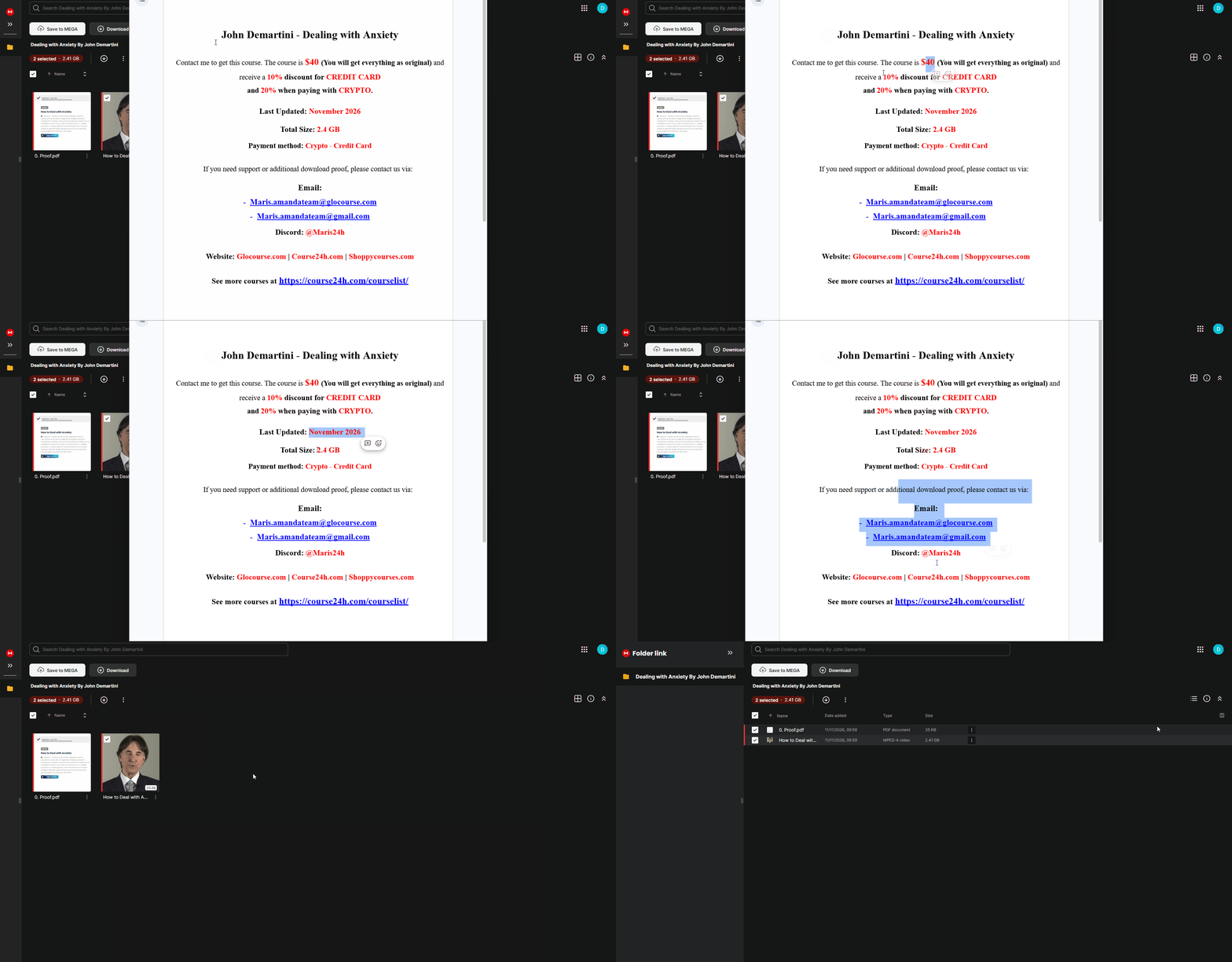
John Demartini – Dealing with Anxiety
Understand the Thinking Patterns Behind Fear and Anxiety
Anxiety can become overwhelming when attention is concentrated on what might go wrong.
Uncertain situations, imagined future outcomes and expectations of loss or difficulty can influence how people interpret their circumstances.
In Dealing with Anxiety, Dr. John Demartini introduces a perception-based approach to understanding the connection between fear,
expectations and emotional responses.
Drawing on the principles of the Demartini Method,
this focused educational session explores how one-sided perceptions may contribute to anxious feelings.
Rather than looking only at the outcomes someone fears,
the material encourages a broader examination of the assumptions and interpretations behind those expectations.
Explore the Connection Between Fear and Future Expectations
A central theme of the session is the way people anticipate future experiences.
According to Demartini’s framework,
anxiety may be associated with expecting more pain than pleasure, more losses than gains, or more challenges than support.
These expectations can shape the way an upcoming event is perceived, sometimes making an uncertain situation appear entirely negative
before it has happened.
The course invites learners to examine questions such as:
What specific outcome am I anticipating?
Which assumptions are influencing my expectations?
Am I focusing exclusively on possible disadvantages?
What aspects of the situation might I not be considering?
This process provides a starting point for recognizing how interpretations of the future can affect present emotional experiences.
Apply the Demartini Method to Anxious Thoughts
Dr. Demartini presents his approach to balancing and neutralizing perceptions as a framework for self-reflection.
Learners are encouraged to investigate the thoughts, expectations and meanings attached to situations they fear.
The session focuses on several connected ideas:
Identify the perceived threat: Clarify the future event or possibility that is creating concern.
Examine the underlying assumptions: Consider why the situation is being interpreted as predominantly painful or unfavorable.
Look beyond one-sided thinking: Explore other aspects of the experience that may have been overlooked.
Develop a broader perspective: Reconsider the meaning attached to the anticipated event.
Through this process, the course introduces a different way to examine the relationship between perception and emotional reactions.
Be the first to review “John Demartini – Dealing with Anxiety”
Related products

Health & Fitness

Hypnosis & NLP



Self-help

Self-help


Seduction
Reviews
There are no reviews yet.