

30 $
We currently only accept Crypto payments on the website. If you’d like to pay via PayPal or Credit Card, please contact us via email shoppycourses@gmail.com and we will provide you with a secure payment link

 GET EXTRA DISCOUNTS
 CHECK ALL OUR EXCLUSIVE COURSES HERE
 Sale Page: https://www.aihero.dev/workshops/ai-coding-crash-course#cloning-the-project-with-git
👉 Check All Exclusive Courses HERE 👈
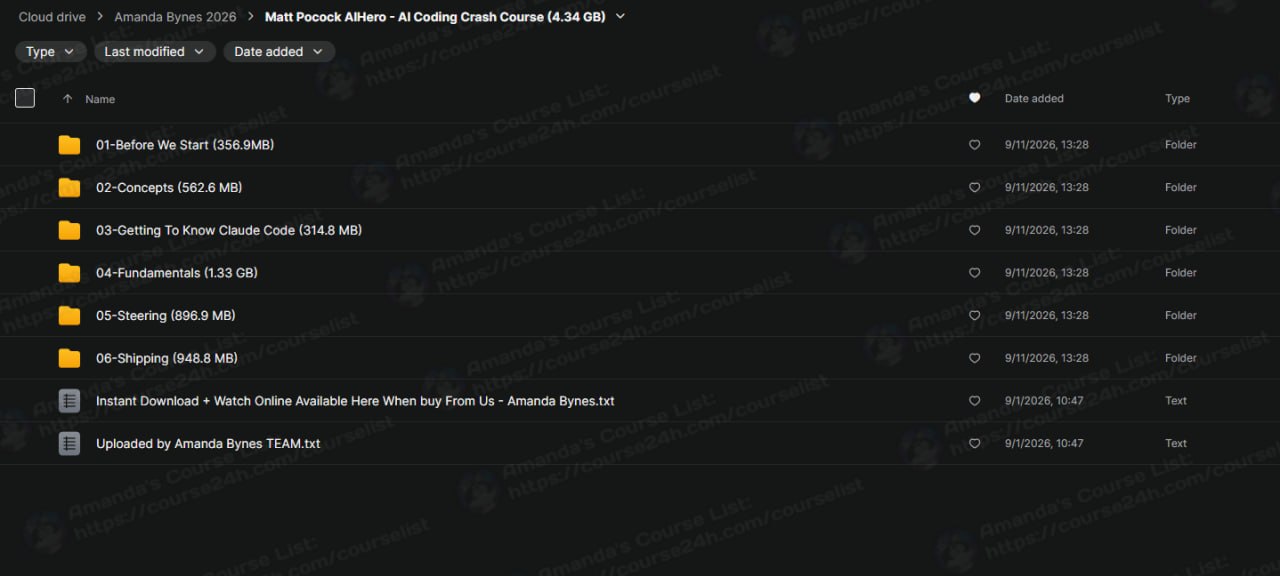
Proof Download
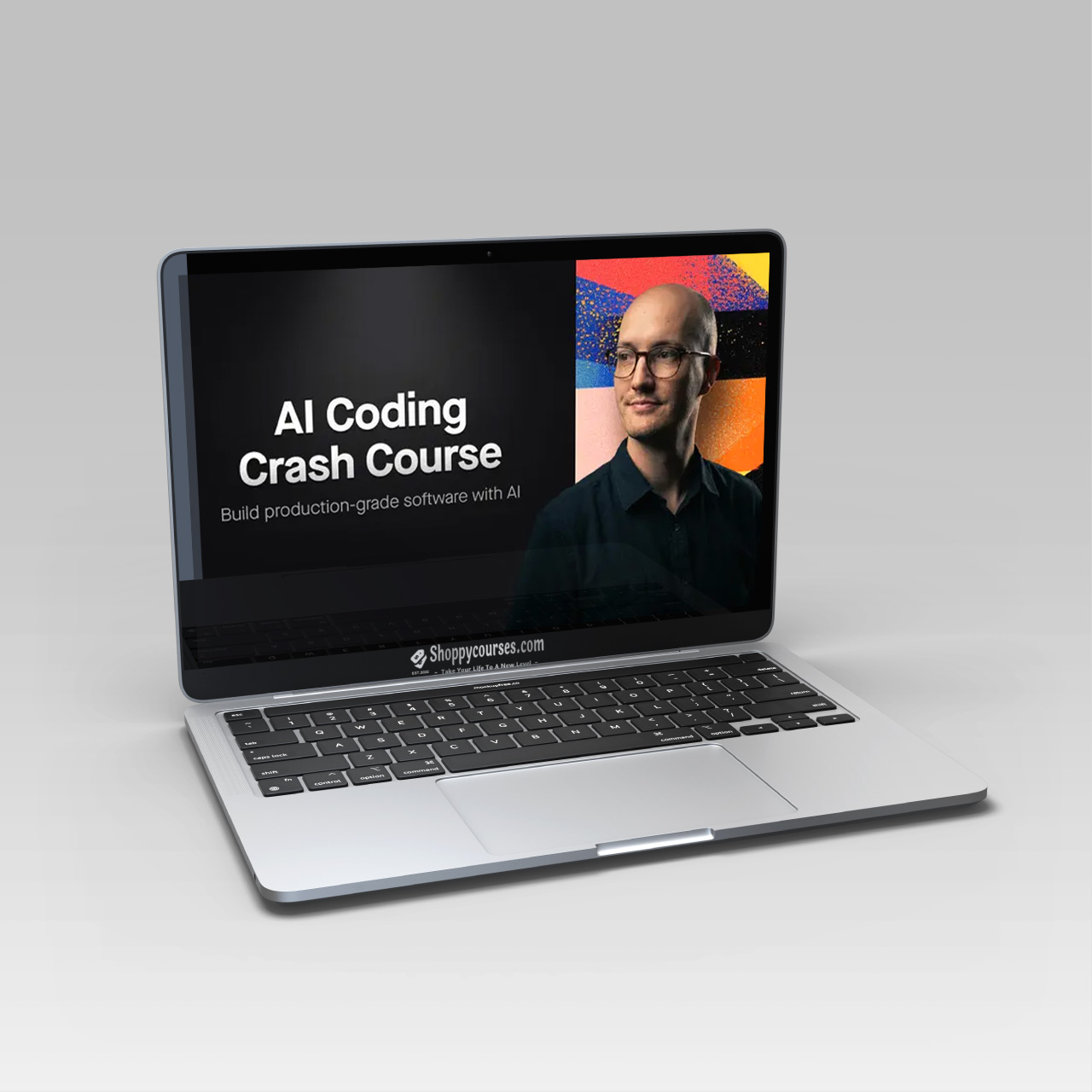
Matt Pocock (AIHero) – AI Coding Crash Course
Learn AI Coding Without Losing Control Of Your Code
AI coding has changed the way software can be built.
A developer can describe an idea, ask an AI coding agent to implement it, and see working code appear in minutes.
Features that once required hours of manual typing can now be explored, generated, tested, and refined with the help of an AI assistant.
But there is another side to AI-assisted development.
The faster an AI agent produces code, the easier it becomes to accumulate code that nobody fully understands.
A small mistake can lead to another workaround, which creates another problem, which requires another prompt.
Eventually, the developer may spend more time reviewing, correcting, explaining, and supervising AI-generated code than actually building.
Matt Pocock – AI Coding Crash Course is designed around solving that problem.
Rather than teaching AI coding as a simple process of prompting an agent and accepting whatever comes back,
the course introduces a more engineering-focused approach to working with coding agents.
The emphasis is on understanding how these systems work, controlling context, defining requirements clearly, exploring codebases, creating reusable instructions,
breaking complex projects into manageable pieces, and maintaining quality as AI takes on more of the implementation work.
The result is a framework for using AI coding tools as part of a reliable software engineering workflow rather than treating them
as an unpredictable code generator.

Understanding What Happens Inside An AI Coding Agent
One of the foundational ideas behind the course is that developers should understand the tools they are delegating work to.
The program explores the relationship between large language models, coding-agent harnesses, and the engineering process
used to turn those capabilities into reliable software.
This distinction matters.
A language model is not the same thing as a coding agent.
The model generates reasoning and text.
The harness gives the agent an environment in which it can inspect files, execute commands, make changes, and interact with a project.
Understanding that architecture makes it easier to reason about why an agent succeeds in one situation and struggles in another.
Instead of treating AI as a mysterious black box, developers can begin understanding:
What the model can see
What information is available in context
How instructions influence behavior
Why context becomes degraded
How agents interact with a codebase
How to divide work between humans and AI
How to verify the resulting implementation
This mental model becomes the foundation for everything that follows.
Using Subagents For Focused Work
Another advanced workflow covered by AI Coding Crash Course is the use of subagents.
Instead of requiring one main agent session to perform every task,
developers can delegate specific exploration or supporting tasks to separate child sessions with fresh context.
This can be useful for work such as:
Research
Codebase exploration
Investigation
Documentation
Focused analysis
Supporting implementation tasks
The larger principle is delegation with boundaries.
AI can take on more work, but the developer still determines how that work is organized and integrated.
Be the first to review “Matt Pocock (AIHero) – AI Coding Crash Course”
Related products








Reviews
There are no reviews yet.