



300 $
We currently only accept Crypto payments on the website. If you’d like to pay via PayPal or Credit Card, please contact us via email shoppycourses@gmail.com and we will provide you with a secure payment link

 GET EXTRA DISCOUNTS
 CHECK ALL OUR EXCLUSIVE COURSES HERE
Sale Page: https://docs.google.com/document/d/1G9p1IDHK63D8s9UcSg1lWQnX6S5FmcUTQsl6XY5jyPc/edit?tab=t.0
👉 Check All Exclusive Courses HERE 👈
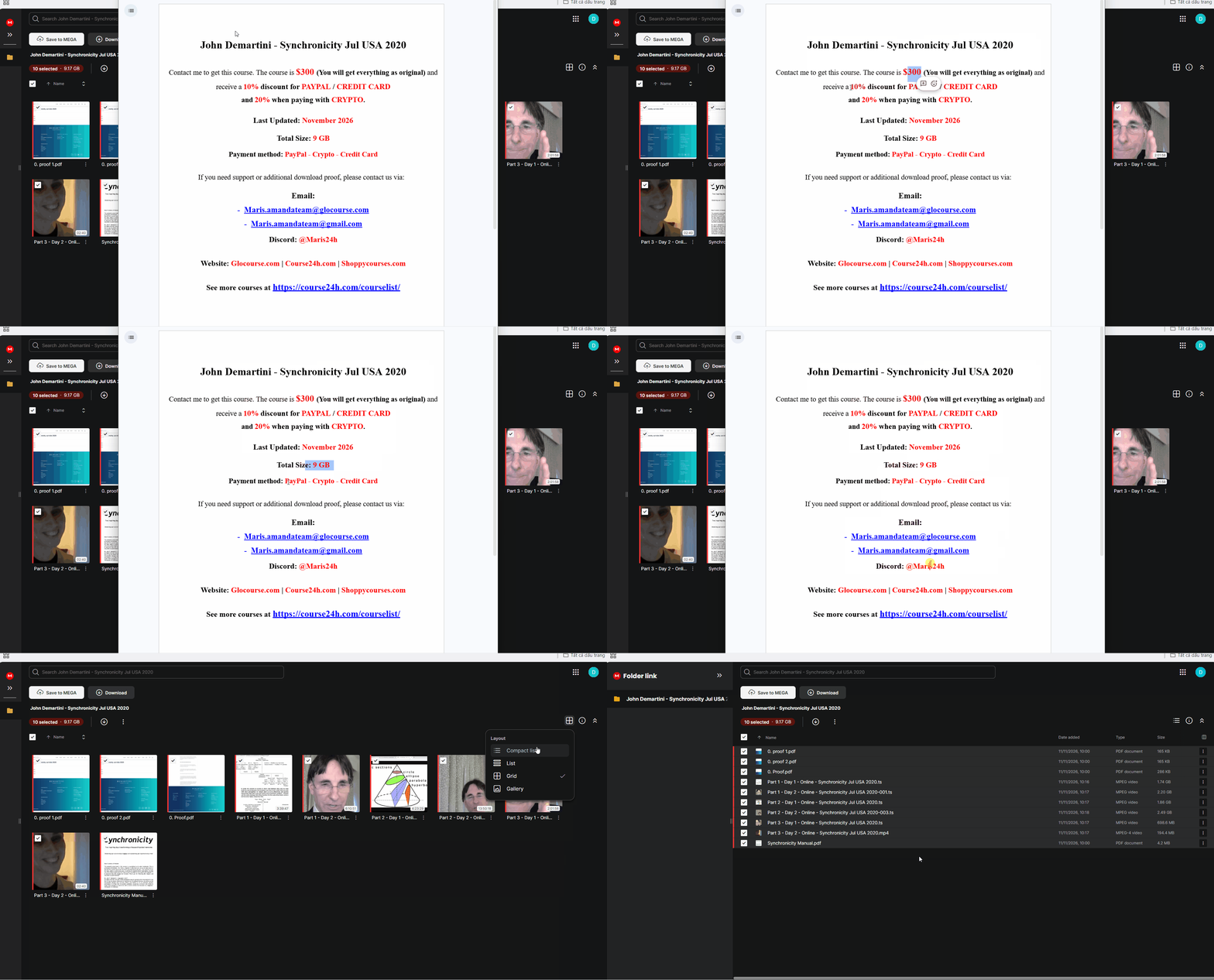
Proof Download
John Demartini – Synchronicity Jul USA 2020
Life is often viewed as a sequence of unrelated events, with some experiences considered positive and others perceived as difficult or unwanted.
But what if seemingly opposite experiences could be understood as connected parts of a larger picture?
John Demartini – Synchronicity explores this perspective through Dr. John Demartini’s philosophy of human behavior, personal awareness,
and the integration of complementary opposites.
The central idea is that greater fulfillment comes from recognizing both sides of an experience rather than becoming attached to one interpretation.
Through the Demartini Method, participants are encouraged to examine their perceptions, reconsider emotionally charged memories,
and discover a more balanced understanding of their personal experiences.

Understand the Meaning of Synchronicity
In Dr. Demartini’s framework, synchronicity refers to recognizing the simultaneous presence of complementary opposites.
Instead of separating experiences into entirely positive or negative categories,
the approach encourages people to identify how both sides may contribute to their development.
This perspective introduces several important concepts:
Hidden order: Explore how experiences that initially appear disconnected may have meaningful relationships.
Complementary opposites: Recognize the benefits and drawbacks that can coexist within the same person, situation, or event.
Emotional balance: Examine perceptions that contribute to resentment, infatuation, blame, or unrealistic expectations.
Present-moment awareness: Develop a more balanced perspective by acknowledging multiple sides of an experience.
Apply the Demartini Method to Personal Experiences
A key element of the Synchronicity philosophy is the Demartini Method,
a structured questioning process designed to help individuals examine emotionally charged experiences.
Rather than simply trying to replace negative thoughts with positive ones, the method encourages a more comprehensive examination of an event.
Participants are guided to consider questions such as:
What were the potential benefits of an experience initially perceived as negative?
What were the limitations or drawbacks of something initially idealized?
How did a challenging situation contribute to personal development?
Which assumptions or expectations influenced the way the experience was interpreted?
By exploring these questions, learners can work toward a more balanced understanding of their experiences and the people involved.
Be the first to review “John Demartini – Synchronicity Jul USA 2020”
Related products

Self-help

Health & Fitness

Hypnosis & NLP

Hypnosis & NLP




Self-help
Reviews
There are no reviews yet.